A Rainy Afternoon with a Homemade Picture Hunt
A homemade picture hunt turns a rainy afternoon into a shared drawing game, with flexible clues, clear room boundaries, and conversation instead of scoring.
The most common mistake in a homemade picture hunt is making every clue a riddle with one exact answer. That costs the game its easy rhythm: players pause to guess what the artist meant instead of noticing the room together. Draw a visual prompt that can point in more than one direction, and a wrong answer becomes a conversation rather than a correction.
For a homemade picture hunt, you need only scrap paper, pencils, and a room with familiar objects. One person draws a clue for someone else to solve, then the roles can shift. There is no prize to hide and no reason to race; the pleasure is seeing how a small drawing changes what someone notices.
Clues with room
A usual scavenger hunt asks players to find a named object. Here, the drawing is the prompt. It might show an object, a detail, a shape, or a tiny scene, and the solver looks for something that fits.
Say a sketch shows a circle with short lines around it. A wall clock, a flower on a cushion, or a toy wheel might all make sense. The solver points to a match and explains the connection. The artist can share the intended answer without declaring another thoughtful reading wrong.
That open-ended approach also gives everyone a way to contribute. A bold outline can be as useful as a careful pattern, and no one needs polished drawing skills. The clue only needs to give another person something to look for.
A simple drawing kit
Use materials that are already handy: printer paper, the blank side of junk mail, sticky notes, or index cards. Pencils are easy to revise. Crayons or colored pencils can separate shapes, while a dark marker is useful for a clear outline but not essential.
- Check that each sheet has a blank area for drawing; if it does, use it for a clue, and if not, turn it over or choose another scrap.
- Check whether the pencil makes a visible mark; if it does, keep it with the cards, and if not, choose a crayon or colored pencil.
- Check whether loose cards stay together in a bowl or envelope; if they do, use that container, and if not, keep the clues in a small stack on the table.
- Check whether everyone can see the drawing surface; if they can, draw there, and if not, use a clipboard or sturdy book as a firm base.
- Check whether a timer would help the group stop naturally; if it would, use it as a gentle reminder, and if it would create pressure, leave it out.
- Check whether the chosen materials are easy to put away; if they are, keep the kit nearby, and if not, use only paper and one drawing tool.
Skip elaborate props, hidden tokens, and a long rule sheet. They add setup without helping anyone read a drawing. It is not worth making every clue equally difficult, either; a mix of direct and puzzling prompts gives players room to ask for help.
Set the search area
Agree on the room before the first clue. A living room, the space around a kitchen table, or one bedroom can offer plenty to spot without sending players across the home. Name anything off limits, such as fragile decorations, private belongings, or objects that should not be handled.
Keep the search safe and mostly stationary. Players can point to an object rather than climb, open cupboards, or move furniture. If a clue seems to point somewhere out of reach, let the solver describe the location instead. Follow any household instructions that apply to an object.
Make participation flexible, too. No one has to draw, guess, or explain on demand. Someone can pass, offer a clue aloud, or simply point out possible matches.
Draw readable prompts
Start with something familiar. A mug needs only a rim and a handle; a houseplant might be a pot, a stem, and one leaf. Leave out details that do not help another person recognize the subject. Perspective and shading are optional.
For a subtler prompt, draw a close-up or a relationship between shapes. Parallel lines might suggest pages in a book, chair slats, or a striped cushion. A small circle beside a larger one could suggest a cabinet knob or a coat button. These drawings make the search interesting without requiring a single secret answer.
Words can help, but keep them optional. A color or category may clarify an abstract sketch; writing the object’s name on the back gives too much away. If someone stalls, offer a hint about a feature or location, such as a curved edge or a shelf, rather than naming the object.
Trade clues and solve together
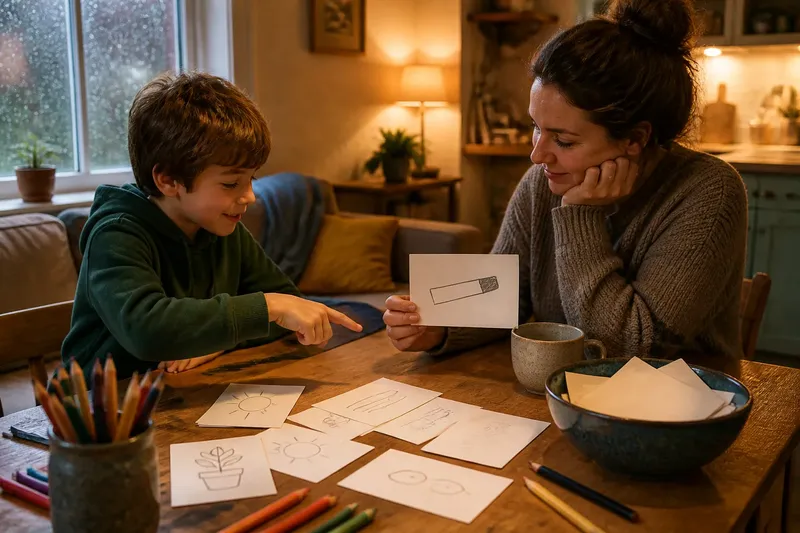
Draw a clue, pass it across the table, and look around together. The solver points to a possible match and names the feature that connects it to the sketch. The artist can explain their intention, then invite another reading. Switch roles when people are ready, not because a turn-taking rule demands it.
Say two people are at a kitchen table on a wet afternoon. One draws a long rectangle with a dark patch at one end. The other first suggests a cutting board, then spots a wooden spoon nearby whose handle resembles the dark patch. They settle on the spoon as a satisfying match, while the artist says they had pictured a serving tray. The result is an explanation they can share, not a score.
A bowl of clues can make the exchange more relaxed. Leave finished cards in the middle, and let anyone draw or choose one when ready. Put solved cards in a second pile if the group wants to revisit drawings that inspired lively interpretations.
What helps a clue land?
What if nobody recognizes the drawing?
Ask for one visual feature, such as color, shape, or location, instead of asking for the answer. If the clue remains unclear, set it aside and let the artist redraw it with a stronger cue.
Can one clue have several answers?
Yes. Let the solver explain the visual connection, then accept more than one reasonable match. The artist can reveal the intended object without canceling someone else’s good interpretation.
What if someone does not want to draw?
Offer another role: choose a clue from the bowl, point out possible matches, or describe a prompt for someone else to sketch. Watching without joining is fine, too.
How can different ages play together?
Mix direct clues with less obvious details, and let anyone ask for help. One person can draw a bold shape while another searches for a pattern or a small feature.
Keep the game cooperative
Points and speed rounds can turn a relaxed drawing game into a test, especially when players draw or interpret at different paces. Treat each card as an invitation to notice something instead. A good round might end with a surprising match, a funny misunderstanding, or someone spotting a detail they had overlooked.
If one person is taking over, invite someone else to pick the next clue while making it clear they can pass. If the room feels busy, shrink the search area to one table or shelf. If people are restless, move to another room after the first area is clear.
Save a favorite clue
When the group is ready to stop, let each person choose a drawing to keep. Add a short note about the answer if that sounds fun, or tuck the card into a book as it is. For the next homemade picture hunt, change the room or try a different kind of visual clue; a fresh setting can make familiar drawings read differently.