Pencil, Pen, or Crayon for a One-Page Sketch?
Choose pencil, pen, or crayon for a one-page sketch by matching erasability and line character to the marks you want to keep on the page.
The common mistake with a one-page sketch is reaching for a pencil just because it seems safest. The cost is a drawing rubbed pale by revisions before it has a chance to feel lively. For a one-page sketch, choose pencil, pen, or crayon by how much you want to revise and what kind of line you want to keep.
Tool and intention
Use a pencil if you expect to adjust shapes, a pen if you want committed lines, and a crayon if you want broad, textured marks. Those are starting points, not rules. A coffee mug might benefit from a crisp outline; a leafy houseplant may suit soft, irregular strokes.
Consider your tolerance for visible marks before you begin. Pencil leaves room for correction but can invite endless editing. Pen makes each stroke count. Crayon announces itself with texture and heavier coverage. On a small page, the medium becomes part of the drawing’s character.
- Pencil: Choose it if you want to adjust proportions or place details lightly; if you want a mark that stays, choose pen or crayon instead.
- Pen: Choose it if you prefer a clean, graphic line and can accept imperfect strokes; if you want frequent revisions, choose pencil instead.
- Crayon: Choose it if you want bold areas, varied pressure, or a rough look; if you want fine, easily changed lines, choose pencil or pen instead.
Revision and erasing
Pencil is the easiest of these three to revise, but erasing does not make every change disappear. A soft graphite mark may lift readily; a dark line pressed into the page can leave a dent or faint trace. A broad eraser can smudge nearby work, especially where lines sit close together.
Pen usually does not erase cleanly. That can help you stop treating every curve as a draft. If a line lands slightly off, let it remain, turn it into a shadow, or add a neighboring line that makes the shape feel intentional. Correction fluid is usually more trouble than it is worth for a casual sketch: it can leave a conspicuous patch that interrupts the paper’s surface.
Crayon is also difficult to remove. Its waxy or oily pigment can cling to the page, and rubbing may spread color rather than clear it. Treat a crayon mark as something to work around. If you need room for frequent changes, it is a poor first choice.
Rather than stopping to make a separate test, notice how the tool behaves as you start: a graphite curve can be softened with an eraser, while a pen stroke or crayon patch asks you to work around it. If a material has specific handling guidance, follow the maker’s directions.
Line and texture
Pencil lines can shift from faint to dark as your hand changes pressure. That range suits soft edges, shading, or a quiet, unfinished quality. Repeated strokes can leave a haze of graphite. A sharp point gives more control; a blunter point makes softer, wider marks.
Pen creates a more even, direct line. A fine-tip pen can describe a handle or a small window; a broader felt-tip pen gives a simple object a poster-like outline. Ink makes overlaps and changes of direction easy to see, which can give a drawing energy. Hesitant, repeated tracing is also more obvious, so try a comfortable motion rather than polishing one edge into a dark knot.
Crayon gives a line with built-in grain. Tilt it on its side for a wide patch, or use the point for a narrower accent. Pressure and paper texture affect the result, so the mark may look uneven in a warm, tactile way. That texture can crowd a tiny sketch if every area gets the same heavy treatment.
Visible marks
Pick the medium whose imperfections you would be happy to keep. Pencil’s searching lines can show how you looked for a shape. Pen’s single strokes can make the drawing feel brisk. Crayon’s waxy streaks can make a plain object feel playful. Visible marks become distracting when they compete with the subject.
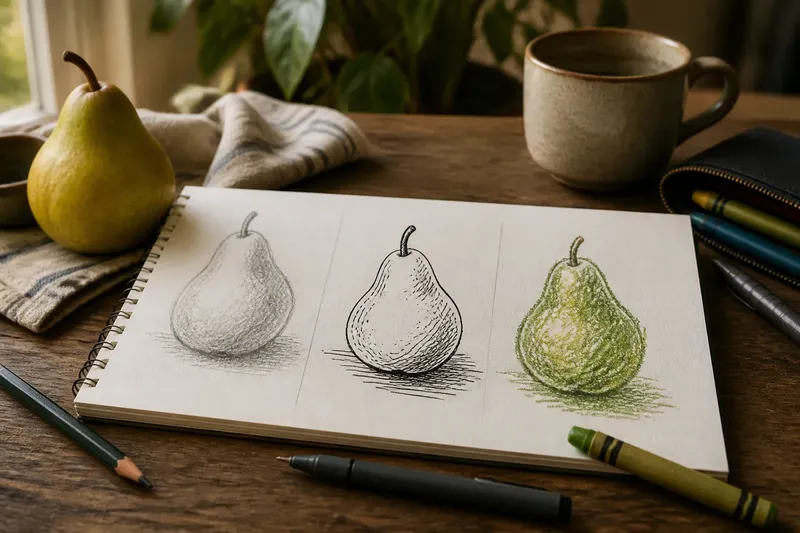
Imagine you are sketching a pear on a single sheet of notebook paper and want the outline to stay adjustable. You begin with pencil, lightly place the contour, and adjust its narrow top; the resulting shape remains easy to revise, with a few crosshatched shadows still visible. If instead you choose pen, the slightly lopsided contour stays as drawn, and short strokes define the stem. With crayon, uneven green strokes leave a textured fill, but you give up easy erasing. The starting page and subject stay the same; the mark you are willing to keep determines the tradeoff.
For a first sketch with a tool, keep the subject simple and leave some open paper. That gives the marks room and lets the material’s natural look show. A dense background is not worth the effort if it only makes a one-page exercise feel finished.
Combining materials
Mixing tools can give a compact drawing both a clear outline and a softer interior. Use pencil for light placement, pen for a few defining edges, or crayon for one bold area beside a fine line. Give each material a job instead of layering all three everywhere.
Say you want to draw a desk lamp on blank paper, and you have a pencil, pen, and yellow crayon. First, sketch the angled arm lightly in pencil. Next, draw the silhouette in pen, choosing only the edges that clarify the lamp. Finally, add a small yellow crayon patch inside the shade. The expected result is a readable shape with one bright, textured accent; the tradeoff is that the crayon area is difficult to revise. If the ink does not look right over the colored patch, leave that area uninked rather than adding more layers.
Crayon can change how later marks sit on the surface, and ink may behave differently over a waxy area than on bare paper. Keep the combination restrained: a few distinct roles are clearer than a stack of corrections.
Sketch questions
People often ask about beginner-friendly tools, familiar pens, notebook paper, and what to carry. The best choice depends on the line you want and how much revision you expect.
Is pencil best for beginners?
Pencil is a forgiving choice if you expect to change the drawing as you go. It is not automatically best for everyone: a pen can feel more relaxing if you want to make one clear mark and move on.
Can I use a ballpoint pen?
Yes. A ballpoint makes a familiar, relatively fine line for small objects and quick outlines. Its marks can vary with pressure, so a lighter touch helps keep the line from becoming too dark.
Will crayon work on notebook paper?
Crayon can leave a visible mark on ordinary notebook paper, though the surface texture affects how evenly it covers. Thin paper may show pressure marks, so use a light hand and avoid repeatedly filling the same spot.
Which material is easiest to carry?
A single pencil or pen is convenient if you want a narrow, tidy line without carrying a full art kit. A short crayon is portable too, but a wrapper or case can keep pigment off other belongings.
Choosing your tool
For a one-page sketch, pencil, pen, or crayon each serves a different intention. Choose pencil if you want to revise, pen if you want a sharp outline that stays, and crayon if you want visible texture and color. The best match is the one whose marks you are willing to keep.
As you begin, make the first few marks small and notice how each one changes the page. Choose the tool that feels closest to the drawing you have in mind, then set the others aside. A slightly imperfect stroke can be the detail that makes the page feel like yours.