The Cardboard Box That Became a Toy
A cardboard box becomes a toy when its shape invites a story. Choose a box by the kind of pretend play you want, from hiding to building together.
The most common mistake with a cardboard box toy is deciding what it should be before anyone has a chance to play. A box covered in decorations can look finished, but that can make it harder for a child to imagine it as anything else. Start with the box’s shape and the kind of play it invites, and an ordinary container can become a hideout, vehicle, shop, or something with no name yet.
Start with the box
Cardboard boxes have stayed appealing as toys because they ask very little of the imagination. A box is already a container, but it can also suggest a doorway, a cabin, a counter, or a shell. Children can assign it a purpose, change that purpose, and make the story as they go. The object does not have to do anything on its own.
That open-ended quality is useful when you are choosing between a ready-made toy and a box. A toy often arrives with a clear job. A box leaves the job undecided. One afternoon it might hold a stuffed animal; later, its flaps might become wings or a roof. The same plain material supports different games without needing a new set of parts.
Look at the box before reaching for tape or markers. Is it low and broad, tall and narrow, or small enough to carry? Are the flaps open, tucked in, or easy to fold back? These features offer a natural starting point. Let the shape suggest possibilities, but leave the final decision to the play.
Match the moment
Choose according to the situation, not an imagined perfect project. A quiet child may want an enclosed place to arrange toys. A busy group may prefer a shared destination or a role-play counter. Someone who likes moving things may enjoy a box that can be pushed or carried. The best fit is often the version that leaves room for the child’s own next idea.
- For a quiet retreat: Choose a large open box with enough space for a child to sit beside it or peer inside. It can stand for a den, a cave, or a sleeping place for stuffed animals. Keep the play accessible rather than turning the box into a closed enclosure.
- For a game with roles: Choose a box with a broad side that can face the players. It can become a pretend shop counter, ticket booth, or mail station. Add a few household props, such as clean paper and toy food, only if they help the game begin.
- For a moving story: Choose a box that is light enough to push or carry safely. It might be a pretend boat, delivery cart, or rover. Let the child supply the destination and passengers rather than drawing a route for them.
- For shared building: Set out several boxes of different shapes. One can become a room, another a gate, and another a place to store pretend supplies. This suits children who enjoy changing the scene together more than decorating a single object.
- For a short, spontaneous play break: Use a small, clean box and leave it mostly as it is. A toy animal can move in, a folded cloth can become a blanket, or the box can simply hold a collection of small toys. It is a good fit when there is little time or energy for preparation.
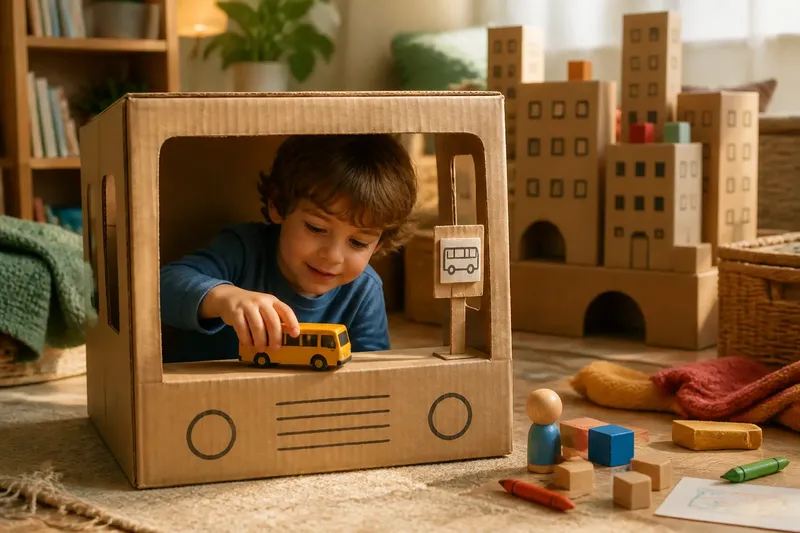
Imagine a child finding a shallow box beside the recycling bin. You set it on the floor without naming it, and the child places a toy bus inside, then announces that the box is a station. A scrap of paper becomes a ticket. The expected result is not a polished model; it is a game that has begun from the child’s own choice.
Leave room to change
Open-ended play works best when the box can change jobs without a redesign. Avoid adding details that settle every question. A few drawn windows may suggest a house, but a full exterior with a fixed label can make it feel like the house is the only option. If a child has a strong idea, follow it. If not, wait before supplying one.
Ask an invitation that leaves several answers possible: “Who might use this?” or “What could go inside?” Then give the child time to answer through play rather than prompting a sequence of steps. If the first idea fades, that is not a problem. The box can become something else without being taken apart.
Small additions can help when they serve the game. A scarf can be a curtain, a paper sign can mark a pretend shop, and a few blocks can stand for supplies. Keep these props separate from the box so they can be moved or reused. The box remains the central object, while the story stays flexible.
Keep setup simple
A box does not need elaborate decoration to feel inviting. If a child wants to personalize it, offer washable markers, crayons, or broad paper shapes to attach with child-appropriate tape. One or two changes can be enough to make the object feel chosen without fixing its identity. It is also fine to skip decorating altogether.
Check that the box is clean and dry, and remove loose packing material before play. Stay nearby when children are using a large box, particularly if they are climbing, pulling, or trying to move it. Follow the product label and manufacturer instructions for any materials or supplies you add.
Not worth the effort: building a miniature set, covering every surface, or cutting detailed features before the child has shown interest. Those jobs can consume the time meant for play and may leave less room for improvisation. If a particular feature matters to the child, add it together as the game develops.
Questions about box play?
What kind of cardboard box works best?
Choose a clean, dry box whose shape suits the play space and the child’s idea. A broad box offers a different invitation from a small one, but there is no single best shape.
Should I decorate the box first?
Usually, leave it plain at first so the child can decide what it is. Add a simple mark or prop if the child asks for one or seems to need a starting point.
How can a box work for more than one child?
Offer a shared purpose with flexible roles, such as a pretend station where children can be visitors, workers, or builders. If their ideas differ, let the box change roles rather than requiring everyone to agree on one permanent design.
What if the child loses interest?
Let the box rest instead of trying to rescue the game with more decorations. It may become interesting again when a new toy, story, or playmate suggests another use.
Let play lead
The useful question is not how to turn cardboard into an impressive toy. It is which box gives the child an inviting place to begin. A plain container can support pretend play precisely because it does not settle the story in advance. Choose a shape that fits the moment, keep the setup simple, and leave enough room for the next idea to belong to the child.