The Trap of Measuring Every Creative Idea
The trap of measuring every creative idea is judging only the finished result. Learn to notice process, discoveries, and small improvements without draining the fun.
The most common mistake with a creative pastime is judging it only by what ends up on the table. The trap of measuring every creative idea is that a lopsided sketch, a wobbly paper creature, or a noisy homemade instrument can seem like a failure before you notice what you learned along the way. That verdict can make the next small experiment feel not worth starting.
Results crowd the view
A finished object is easy to point to. It is harder to see the decisions that got it there: changing a pencil angle, trying another color, or realizing that a cardboard shape needs a different base to stand. When the result becomes the only scorecard, those decisions disappear from view.
This is common with quick weekend projects. You may begin with a picture in mind and compare every mark or seam with that imagined version. But an idea in your head has not had to deal with blunt scissors, a wobbly table, or a marker that bleeds through. The work is not failing simply because the materials have their own say.
Try naming what you did rather than grading what you made. “I found a way to keep the pieces together” is more useful than “It looks bad.” The first note gives you something to carry into another session. It also leaves room for an imperfect object and a worthwhile afternoon.
Notice the working moment
Process is the small, observable part of an activity that holds your attention. You might like the soft drag of a wax crayon, the sound of scissors moving through thin card, or the puzzle of arranging loose parts into a small scene. These details count even if the finished piece is headed for the recycling bin.
Give yourself a small signal to notice them. When you pause to rinse a brush, sharpen a pencil, or clear a corner of the table, ask what has been satisfying so far. Keep the answer concrete: “I like testing these two colors together,” not “I should be more creative.” A specific observation is easier to remember and repeat.
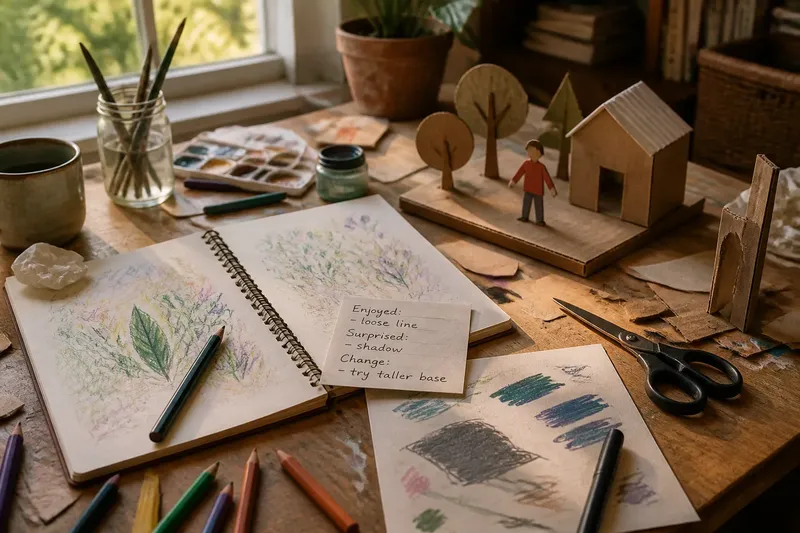
There is no need to record every thought. A single note beside a sketch can be enough: “The broad marker made the shadow easier to place,” or “The taped edge got in the way.” If writing interrupts the pleasure, simply notice the detail and continue. Reflection should support the activity, not become a new assignment.
Let surprises count
Experiments often produce a result you did not plan. A cardboard figure may refuse to stand but cast an interesting shadow. A drawing may take an unexpected turn because a line went crooked. These are not automatically improvements, and you do not have to pretend to like them. They are clues about what happened when your idea met the materials.
Say you set out to draw a made-up garden in a small notebook. The first leaves look stiff, so you try making a few with one loose, curved line instead of outlining each one. The page may still feel uneven, but you can see that the looser marks make the plants feel more lively. That visible difference is a discovery, even if you decide the original plan was better.
When something surprises you, ask a narrow question: “What changed?” Perhaps the paint spread because the page was damp, or a cardboard strip held its curve after you bent it around a marker. You do not need to turn one result into a rule for every project. One observation can be enough to inform the next attempt.
Small improvements matter
Improvement does not have to mean making a polished object. It can mean finding a more comfortable way to hold a pencil, keeping glue off the table, or choosing a piece of scrap that is easier to handle. These changes may be modest, but they affect how the activity feels while you are doing it.
Choose one thing to notice during a session. If you are sketching, you might watch whether a light first mark helps you place the main shapes. If you are assembling a small model, notice whether setting the parts out in advance makes the next choice clearer. Avoid trying to improve everything at once; too many targets can turn a playful afternoon into a performance review.
It can help to compare the current attempt with your own earlier attempt, rather than with a polished picture from elsewhere. Look for one difference you can actually see or feel: a steadier line, a cleaner join, or a clearer sense of where to begin. The comparison is useful only if it points toward a choice you can make next time.
Questions worth asking
How can I enjoy a project that looks messy?
Pick out one part of the process that held your attention, then name one thing you learned from the mess. You can still decide not to keep the object; enjoyment does not require calling every result successful.
Should I keep every unfinished idea?
No. Keep an unfinished piece only if you want to return to it or if it contains a useful reminder about a material or choice. A quick sketch or written note can preserve the idea without saving every scrap.
What if I want a finished object?
That is a perfectly good aim. Give the project a practical purpose, such as making a bookmark or drawing a card, while leaving room to appreciate one pleasant moment or useful discovery along the way.
How do I track progress without scoring myself?
Write a brief observation about a choice, a surprise, or a small change that helped. Avoid turning the note into a rating; its job is to make your experience easier to remember, not to rank it.
Keep the notes light
A notebook can hold a few lines about what you tried, what behaved differently than expected, and what you might do next. It does not need a formal system. If you use one page for several ideas, leave enough space to recognize which note belongs to which project. A date or a small doodle can help, but elaborate tracking is not required.
For a drawing session, a useful note might be, “The short pencil marks made the tree bark feel less stiff.” For a tabletop scene, it might be, “The small figure looked clearer after I moved it away from the background.” These notes are not proof that a choice always works. They are reminders of what you noticed with the materials in front of you.
What is not worth the effort? Photographing every stage, keeping every offcut, or assigning a score to each pastime can take more attention than the activity deserves. If documentation starts to feel like a chore, stop. A few remembered details are enough to shape a future choice.
Choose a kinder measure
Before putting a project away, ask three simple things: What did I enjoy doing? What surprised me? What would I change if I tried again? You do not need a satisfying answer to every question. The point is to look beyond the final appearance and notice the experience you actually had.
The trap of measuring every creative idea loosens when the result becomes one part of the story, not the whole judgment. You might keep a rough drawing, recycle a failed cardboard shape, or leave a half-built contraption on the desk for another day. The useful measure is whether you found something worth noticing—and whether you feel curious enough to make another small attempt.